
The Civil War Didn’t Start at Fort Sumter: Bleeding Kansas Came First
The American Civil War didn’t start at Fort Sumter.
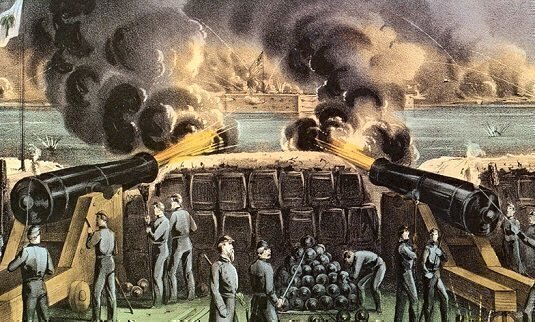
Fort Sumter was where the country finally had to admit how far things had gone. Americans had already been bleeding each other for years before Confederate cannon opened fire in Charleston Harbor. The Library of Congress describes the struggle in Kansas as a “foreshock” of the Civil War, and by June 1856 newspapers were already describing Kansas as being in a state of civil war.
The first crack opened two years earlier, when Congress passed the Kansas-Nebraska Act.
The Kansas-Nebraska Act Lit the Fuse
The Kansas-Nebraska Act created the Kansas and Nebraska territories and allowed settlers living there to decide through popular sovereignty whether slavery would be permitted.
Senator Stephen A. Douglas of Illinois wanted the western territories organized. Settlement was moving west, and Douglas also supported a transcontinental railroad running west from Chicago.
The problem was that much of the territory sat north of the old Missouri Compromise line, where slavery had previously been prohibited. Southern senators were not going to support Douglas’s plans while watching slavery get locked out of the new territories. Missouri senator David Atchison was among the men who pushed Douglas to remove that restriction.
Douglas agreed. A later historical account records him telling Atchison:
“I will incorporate it into my bill, though I know it will raise a hell of a storm.”
He understood what he was opening up.
What had started as a fight over settlement, railroads, territorial government, and western expansion quickly centered on one poisonous question: Would Kansas become slave or free?
Northern antislavery organizations encouraged settlers to move into Kansas. The New England Emigrant Aid Company helped transport settlers, founded towns, built mills and hotels, supported newspapers, and openly hoped Kansas would become a free state.
And let’s be fair to the Missouri side here.
The company was real, and its political goals were real. It intended to influence what Kansas became. It also hoped its settlements would increase land values and make money for investors. Later, company directors helped funnel weapons to Free-State settlers, although that came after the first Missouri election incursion.
So when Missouri politicians and newspapers warned that Northern emigrant-aid societies intended to “abolitionize” Kansas, they were not inventing the entire thing.
The reaction went much further.
The First Kansas Election Was Already a Warning
On November 29, 1854, Kansas held its first territorial election. Large numbers of Missourians crossed the border to vote in an election that did not belong to them.
A later congressional investigation counted 2,833 votes and estimated that 1,729 were illegal. The committee concluded that a large majority of those illegal votes had been cast by Missouri residents.
There is one detail that makes the whole thing almost stupid.
The committee also concluded that proslavery candidate John Whitfield would have won a plurality of the legal votes anyway.
They didn’t even need to steal the damn election.
But they did.
Thousands of settlers had now watched men cross a state line to help decide what Kansas was going to become. At the same time, Missourians could point east and see organized Northern groups sending settlers into Kansas for the openly stated purpose of making it free soil.
Both sides walked away with proof for the story they already wanted to believe.
Missourians could say Northern abolitionists were sending people west to take Kansas from them. Free-Staters could point across the Missouri line and say proslavery men would simply cross the border and take elections instead.
Everybody gets to be the victim in their own story, and that is when things get ugly.
Bleeding Kansas Became an Information War
The newspapers helped pour fuel on it.
Missourians became Border Ruffians. Kansas opponents became Free-Soilers, abolitionists, Yankees, and later Jayhawkers.
It is worth remembering how people received information in the 1850s. There was no video in your pocket, no livestream, and no way to watch most events unfold for yourself. Somebody told you what happened, usually after they had already decided what it meant.
That somebody could be a politician, neighbor, preacher, traveler, or newspaper editor.
Then you decided who to believe.
One of the earliest examples came from Missouri itself. In April 1855, the Industrial Luminary in Parkville criticized proslavery interference surrounding Kansas elections. Roughly two hundred men gathered and marched to the newspaper office.
The editors were threatened with tar and feathers. One was spared after his wife pleaded for him. The printing press was hauled through town and dumped into the Missouri River with a label reading “Boston Aid.”
The mob passed resolutions calling the editors traitors and threatened to hunt them down if they moved into Kansas.
Free-State newspapers later got their turn.
The Herald of Freedom and Kansas Free State presses were destroyed during the Sack of Lawrence in May 1856. The Territorial Register had already been smashed and thrown through the Missouri River ice months earlier.
These newspapers were not simply reporting the conflict. Some were active participants in it.
The Herald of Freedom promoted the Free-State cause. The Kansas Free State did the same. On the other side, the proslavery Squatter Sovereign became one of the nastier voices in the territory and called for abolitionism and Free-Soilism to be driven out.
Money was mixed in too. The New England Emigrant Aid Company bought property and expected settlement to increase land values. Town companies wanted their settlement to win. Merchants supplied migrants, hotels housed them, and newspapers promoted them.
The company hoped to raise millions. It never came close and eventually failed to make money for its stockholders, but the intention had been there from the beginning.
Politics and profit had climbed into the same wagon.
How Ordinary Grievances Turn Into Political Violence
Something about all this reminded me of a much later study.
In 1966, the U.S. Army published Human Factors Considerations of Undergrounds in Insurgencies, prepared through American University’s Special Operations Research Office by Andrew R. Molnar and his colleagues.
The study examined how underground movements form, how propaganda works, how grievances become political, and what turns otherwise passive people into active participants.
One observation fits Bleeding Kansas almost perfectly.
People who do not strongly identify with an abstract political issue can still react intensely once that issue becomes attached to an apparent injustice or a brutal attack against somebody they see as innocent.
The study summed it up this way:
“A martyr turns an ordinary grievance into an emotional crusade.”
That is the part to keep in mind as the border starts producing bodies.
Charles Dow and the Wakarusa War
By the fall of 1855, both sides were more suspicious and more heavily armed.
Then Charles Dow was killed.
Dow was a Free-Stater. Franklin Coleman was proslavery. Their fight grew out of a land dispute, not some grand showdown over the future of slavery.
On November 21, 1855, Coleman shot Dow dead.
A personal feud between two pissed-off neighbors had landed inside a political powder keg.
Dow was no longer simply a man killed over land. He became a Free-State man killed by a proslavery man, and that distinction carried political weight.
Attempts to arrest Dow’s Free-State associate Jacob Branson, followed by the rescue of Branson, helped trigger the Wakarusa War. Militias formed, Lawrence fortified itself, Missouri forces gathered nearby, and weapons began moving into Free-State hands.
Early in 1856, minister Henry Ward Beecher argued that a Sharps rifle carried more practical moral power in Kansas than a hundred Bibles. The rifles soon earned a nickname:
Beecher’s Bibles.
Once again, both sides had evidence for the story they already believed.
Proslavery Missourians could point at rifles being shipped west and argue that armed abolitionists were invading Kansas. Free-Staters could point back at Missouri election interference and answer, Why the hell do you think we need rifles?
That is how escalation works. One side’s defense becomes the other side’s proof of aggression.
Skirmishes followed, while newspaper stories grew larger as they traveled. Heroes and villains appeared on the page, death counts swelled, and the phrase Bleeding Kansas began to fit the place.
Meanwhile, the starch-collared vultures circled.
A frightened settler needed supplies. A growing town needed people. The more important that town became, the more valuable somebody’s patch of dirt became.
Not everyone needed to believe deeply in the cause. Some people simply needed the fight to keep bringing settlers west.
Politics and profit were riding together.
John Brown and the Pottawatomie Killings
Then John Brown entered the story.
If Missouri needed a boogeyman, Brown was damn near designed for the job. He was an intense Bible-reading abolitionist who believed slavery was a sin against God and that violence could be justified against it.
W. E. B. Du Bois later recorded a statement attributed to Brown:
“God is my judge—we were justified under the circumstances.”
Brown fought in several Kansas clashes, but what happened at Pottawatomie Creek in May 1856 burned his name into Missouri memory.
Free-State settler James Hanway later remembered Brown saying he intended to “regulate matters” along the creek. When another man urged caution, Brown became angry. He had heard enough about caution and had begun to see it as another name for cowardice.
Hanway wanted nothing to do with the plan because he understood what happened when one side began dragging men out of their homes. The other side answered, then somebody answered them, and before long nobody cared who started it.
Brown’s party moved out after dark on May 24, 1856.
James Townsley went with them and supplied the wagon. More than twenty years later, he gave an account of what happened. By then Brown had become a martyr to many people in the North, and his defenders had spent years arguing over his responsibility for the killings.
Townsley had been there.
The group carried pistols and rifles, but they also brought short, heavy, two-edged swords. Men were dragged from their homes within earshot of wives and children and killed. Five men were dead by the end of the night.
News of the killings exploded across the border.
Contemporary appeals to territorial governor Wilson Shannon reported:
“All is excitement here; court cannot go on.”
Another message said:
“Families are leaving for Missouri.”
Militia officers begged for weapons, and one appeal ended with:
“For God’s sake send arms.”
A political argument over popular sovereignty had now come through somebody’s front door.
Bleeding Kansas Made the Coming War Personal
The killings and robberies did not stop after Pottawatomie, and neither side suddenly regained its senses.
Political violence, raids, militia activity, retaliation, robbery, and later guerrilla warfare kept eating away at the Kansas-Missouri border.
The formal political question over whether Kansas would enter the Union slave or free was slowly being decided. The hatred left behind was not.
By the time the wider country fell apart in 1861, people along the border had already spent years learning how to fear one another.
They had dead neighbors, burned farms, political enemies with names and faces, and stories about atrocities passed around dinner tables, taverns, camps, newspapers, and churches.
Fort Sumter made the war national.
Along the Kansas-Missouri border, Americans had already crossed the line from political argument into organized violence, armed camps, raids, killings, and retaliation.
That is why I do not treat April 1861 as the clean beginning of the American Civil War.
Fort Sumter was when the rest of the country caught up.
By then, it was already personal.
Sources
Library of Congress. “Bleeding Kansas: Topics in Chronicling America.” Chronicling America: Historic American Newspapers.
U.S. Senate Historical Office. “The Kansas-Nebraska Act.” United States Senate, May 30, 1854.
National Park Service. “Early Kansas Elections.” U.S. Department of the Interior.
Kansas Historical Society. “New England Emigrant Aid Company Papers.”
The St. Louis Luminary. “Great Excitement in Platte County, Mo.—Destruction of the Parkville Luminary by a Mob.” April 28, 1855, Vol. 1, No. 23.
Kansas Historical Society. “Kansas Territorial Newspapers.”
Kansas Historical Society. “Beecher Bibles.” Kansapedia.
Kansas Historical Society. “John Brown.” Kansapedia.
Kansas Memory, Kansas Historical Society. “Kansas Territory versus John Brown Sr., Frederick Brown, Oliver Brown, Owen Brown, and Solomon Brown for Murder.” 1856.
West Virginia Archives and History. “John Brown: Chapter Five—Primary Documents.”
Spring, Leverett W. Kansas: The Prelude to the War for the Union. 1885.
Du Bois, W. E. B. John Brown. 1909.
Molnar, Andrew R., Jerry M. Tinker, and John D. LeNoir. Human Factors Considerations of Undergrounds in Insurgencies. Department of the Army Pamphlet 550-104. Special Operations Research Office, American University, 1966.
U.S. Census Office. Eighth Census of the United States, 1860: Agriculture—Missouri.