

November 1871. Ujiji, a slave-trading town on the east shore of Lake Tanganyika.
A crowd gathers because a caravan has come in off the road with the American flag at the head of it. Leading that caravan is a thirty-year-old Welshman who has spent eight months walking into the middle of Africa.
The other white man in Ujiji, the only one for a thousand miles in any direction, comes out to meet him. He is grey. He has lost most of his teeth. He has been out of contact with the outside world for six years.
What happens next is eight words that outlived both men.
Except the pages are torn out.
Two pages of Henry Morton Stanley’s diary, covering the moment he first laid eyes on David Livingstone, were cut out at some point and never recovered. [1] [2] Neither man put the line in a letter home. Livingstone, writing about that day, remembered something else entirely: the reaction of his servant Susi. [2]
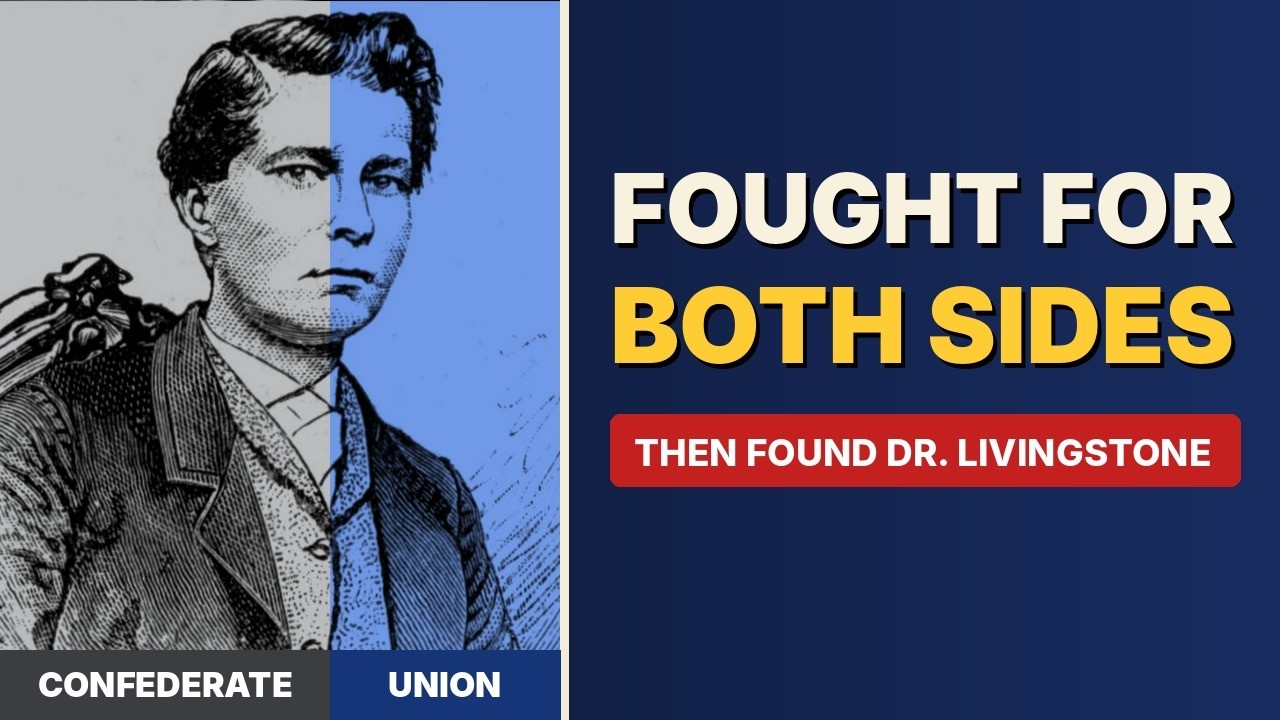
And nine years before any of it, the man who said it was a Confederate private lying in the mud at Shiloh.
Who Was Henry Morton Stanley?
Five men, in order, and all of them the same person.
- John Rowlands — born in Denbigh, Wales, January 28, 1841, and raised in a workhouse [3]
- A Confederate private — 6th Arkansas Infantry, at Shiloh, April 6, 1862 [4]
- A galvanized Yankee — sworn into the Union Army out of a prison camp, June 4, 1862, and listed as a deserter that August [4]
- A Union sailor — ship’s clerk aboard the USS Minnesota, who walked off on a forged pass in February 1865 [2] [4]
- Sir Henry Morton Stanley — the most famous explorer in the world, and the man who built King Leopold II’s road into the Congo [2]
In this article: did he really say it? · the workhouse boy · a Confederate at Shiloh · Camp Douglas and Union blue · deserting the Navy too · “Find Livingstone” · 999 days across Africa · Bula Matari · what he was · FAQ
Did Stanley Really Say “Dr. Livingstone, I Presume”?
Probably not. Here is what the record actually holds.
The line does not appear in Stanley’s journal from the time. The two pages immediately following his first sighting of Livingstone were torn out, and nobody knows by whom or when. [2]
Neither man mentioned the greeting in any letter written in the weeks afterward. Livingstone, recounting the meeting, wrote about Susi running ahead to tell him an Englishman was coming. [2]
The sentence first reaches print the following summer, in the New York Herald on July 1, 1872, and in a summary of Stanley’s letters that ran in the New York Times the next day. [2] By then Stanley had been home long enough to decide what the scene should sound like.
His biographer Tim Jeal, who went through the diaries, concluded that Stanley invented the line later, and that he did it out of insecurity about where he came from. [1] [2] A workhouse boy with a borrowed name needed to sound like a gentleman who had been raised to meet a legend in the jungle. So he wrote himself one.
The press of the day found it ridiculous. Absurdly stiff, they said, for two men standing in a slave market on a lake nobody in London could find. [2]
Here is the part that gets me. It is the most famous thing he ever said, and it is probably the least true thing in a life with a lot of competition for that title.
The Workhouse Boy Named John Rowlands
He was born John Rowlands in Denbigh, Wales, on January 28, 1841. His grandparents put him in the local workhouse while he was still small, and he stayed there until he ran. [3]
He got to Liverpool and signed on as a cabin boy on an American ship. In February 1859 he came off it onto the docks at New Orleans, eighteen years old, with nothing. [3]
A cotton broker named Henry Hope Stanley gave him work as an errand boy and then something closer to a father’s attention. The boy took the man’s name and kept it for the rest of his life. [3]
That is worth sitting with for a second. Before he was twenty he had already learned that you can walk off a boat and become somebody else by saying so.
A Confederate at Shiloh
By 1861 he was clerking at Cypress Bend, up near Pine Bluff, Arkansas, and he joined the 6th Arkansas Infantry. [3] His company was called the Dixie Grays.
On April 6, 1862, before dawn, the Dixie Grays went forward at Shiloh. [4] Stanley wrote later that a stray round caught him at the belt clasp and knocked him flat. He got up.
The next morning, after the first day’s fighting had gone the Confederacy’s way and the second day had not, six Union soldiers found him. His own account of the moment is one of the most honest sentences he ever wrote: “I dropped my weapon incontinently.” [4]
Camp Douglas and the Union Blue
They sent him to Camp Douglas in Chicago, and he was there about six weeks. He described the place as one where the prisoners were “simply doomed.” [4] He was not being dramatic. Men died there in numbers.
Then came the offer. Swear allegiance to the United States, put on blue, and walk out of here. On June 4, 1862, he took it. [4]
He was not unusual. Roughly 5,600 Confederate prisoners made the same trade over the course of the war. [4] [5] The men who took the oath got a name for it from the prisoners who didn’t: galvanized Yankees, after a bucket of iron with a thin coat of zinc over the top. A Rebel with a thin coat of blue. The full story of the Galvanized Yankees and where the Army sent them is here, and there is a video too: Why Did These Confederates Put On Union Blue?
Stanley’s turn in Union blue lasted weeks. At Harpers Ferry he came down with dysentery and fever and went into the hospital. His regiment moved on a few days later. He never reported back, and on August 31, 1862, the Army put him on the books as a deserter. [4]
Years later he wrote that he had been given a medical discharge. He had not. [4]
Then He Deserted the Navy Too
He turned up in New York in October 1863, and about eight months after that he enlisted in the Union Navy under the name Henry Stanley, shading the details on the paperwork as he went. [4]
They made him ship’s clerk aboard the steam frigate USS Minnesota. His job was keeping the daily log. He was aboard for the bombardment of Fort Fisher, off Wilmington, North Carolina, which is the closest he came to a decisive action in four years of war. [2] [4]
On February 10, 1865, with the Minnesota tied up for repairs at Portsmouth, New Hampshire, Stanley and a shipmate named Lewis Noe forged leave passes and walked away. [2] [4]
Count it up. Confederate infantry, Union infantry, Union Navy. He left the last two without permission. The man whose job was to keep the official record of the ship is the same man who forged a document to get off it.
One thing I want to be careful about, because you will see it repeated: he is often called the only man who served in all three. No good source says that. He was one of a number. He was just the one who got famous.
“Find Livingstone”
What he turned out to be good at was writing. He got himself hired as a newspaperman, and he was better at it than he had been at anything else.
James Gordon Bennett of the New York Herald gave him an assignment that was either visionary or a stunt, depending on how generous you feel: go into the middle of Africa and find David Livingstone, a Scottish missionary who had not been heard from in years and was widely assumed to be dead. [3]
Stanley left Zanzibar on March 21, 1871. He reached Ujiji on November 10. [3] Eight months, on foot, to deliver a line he may not have said.
The two men got on. Stanley stayed four months. Livingstone would not come home, and he died in Africa the following year.
999 Days Across Africa
The thing nobody remembers about Stanley is the expedition that should have made him. Between 1874 and 1877, paid for by the Herald and London’s Daily Telegraph, he crossed the continent from east to west and traced the Lualaba downriver until it turned into the Congo. [2]
He came out at the Portuguese post of Boma on August 9, 1877, after 999 days. [2]
He had started with 228 people. One hundred fourteen finished. [2]
Read that twice. Half the expedition died getting the map drawn, and the number most people know about Henry Morton Stanley is eight words he probably made up.
Bula Matari: Breaker of Rocks
Here is where the story stops being an adventure.
Stanley had opened the Congo basin on a map, and King Leopold II of Belgium had been looking for someone to open it in fact. They met in June 1878. By November, Stanley had signed a five-year contract. [2]
From 1879 he worked under Leopold’s committee for the upper Congo. He left Vivi on February 21, 1880, and did not reach Stanley Pool until December 3, 1882, because the job was to build a road around the rapids that made the lower river unnavigable. He founded the station that became Léopoldville, and is now Kinshasa. [2]
The labourers who broke that road out of the rock gave him the name he is still called in the Congo. Bula Matari. Breaker of Rocks. [2]
Adam Hochschild read that as the compliment it sounds like, a hard man admired by hard men. But the Congolese worker who is supposed to have coined it, Nsakala, may well have meant it as a joke at Stanley’s expense. [2] Both readings have survived, which is about right for Stanley. Nobody has ever been able to settle on one version of him either.
The Berlin Act was signed on February 26, 1885, and Leopold walked away with the Congo as personal property. Stanley was recalled and replaced. [2] What Leopold’s state then did to the people of the Congo over the next twenty years is one of the great crimes of the century, and Stanley was not the man administering it.
He was the man who built the road in.
What He Was
I get asked to settle these. Hero or villain. Pick one.
I’m not going to, and not because I’m dodging it. Stanley is a case where the honest answer is that both files are thick. He was a workhouse child who taught himself out of nothing, crossed a continent on foot, and wrote better than most of the men who sneered at him for not being born right. He also fought for slavery, swore an oath he broke, forged a pass, invented the line he is remembered for, buried half an expedition, and cut the first road into Leopold’s Congo.
What I keep landing on is that the lying and the walking were the same instinct. A man who learns early that he can become somebody else by saying so will keep saying so, and the distance he put between the St. Asaph workhouse and a knighthood is the distance he had to keep moving to stay ahead of John Rowlands.
Eight words in a slave market on Lake Tanganyika. He probably never said them. They are carved on him anyway.
More in this series: the Kingdom of Dahomey and the last slave ship, and on how I try to handle men like Stanley, why we study history instead of scoring it.
Henry Morton Stanley FAQ
Did Stanley really say “Dr. Livingstone, I presume”?
Almost certainly not, at least not that day. The line is missing from Stanley’s journal, the two pages following his first sight of Livingstone were torn out, and neither man mentioned it in letters at the time. It first appeared in print in the New York Herald on July 1, 1872. Biographer Tim Jeal concluded Stanley invented it afterward. [1] [2]
What was Henry Morton Stanley’s real name?
John Rowlands. He was born in Denbigh, Wales, on January 28, 1841, and took the name Henry Morton Stanley in New Orleans from a cotton broker, Henry Hope Stanley, who had taken him on as an errand boy. [3]
Was Henry Morton Stanley a Confederate soldier?
Yes. He enlisted in the 6th Arkansas Infantry in 1861 and fought at Shiloh on April 6, 1862, with a company called the Dixie Grays. He was captured the following morning. [3] [4]
Did Stanley fight for both sides in the Civil War?
He served on both sides, though he barely fought for the second one. After about six weeks in Camp Douglas prison camp he swore allegiance to the United States on June 4, 1862, and enlisted in the Union Army as a galvanized Yankee. He fell ill at Harpers Ferry, never rejoined his regiment, and was listed as a deserter on August 31, 1862. He later enlisted in the Union Navy as well. [4]
Did Stanley desert the Union Navy?
Yes. He was ship’s clerk on the USS Minnesota and was present for the bombardment of Fort Fisher. On February 10, 1865, while the ship was under repair at Portsmouth, New Hampshire, he and a shipmate named Lewis Noe left using forged passes. [2] [4]
How long did Stanley take to cross Africa?
999 days. He crossed from east to west between 1874 and 1877, traced the Lualaba into the Congo, and reached Boma on August 9, 1877. He set out with 228 people and finished with 114. [2]
What does Bula Matari mean?
“Breaker of Rocks,” in Kongo. It was the name given to Stanley by the labourers who built his road around the Congo rapids. Whether it was admiration or mockery is still argued over. [2]
Was Stanley responsible for the Congo Free State?
He made it possible without running it. Stanley worked under contract to King Leopold II from 1878, built the road past the lower Congo rapids, and founded Léopoldville, now Kinshasa. He was recalled around the time the Berlin Act of February 26, 1885 handed Leopold the territory, and the atrocities that followed were carried out by Leopold’s administration. [2] [6]
Sources and Further Reading
- Tim Jeal, Stanley: The Impossible Life of Africa’s Greatest Explorer (Yale University Press, 2007)
- “Henry Morton Stanley,” Wikipedia: en.wikipedia.org
- “Henry Morton Stanley (1841–1904),” Encyclopedia of Arkansas: encyclopediaofarkansas.net
- “Henry Morton Stanley Goes to War,” HistoryNet: historynet.com
- Michèle T. Butts, “Trading Gray for Blue,” Prologue, National Archives, 2005: archives.gov
- Adam Hochschild, King Leopold’s Ghost (Houghton Mifflin, 1998)
- Henry M. Stanley, How I Found Livingstone (1872), full text at Project Gutenberg: gutenberg.org
- Henry M. Stanley, Through the Dark Continent (1878)
- “Galvanized Yankees,” Wikipedia: en.wikipedia.org